Rethinking Forest Management and Resin Extraction
Drop the old assumption that scoring tree trunks severely stunts timber development and wrecks your woodland investment. For decades, many have firmly believed that harvesting resin guarantees a weakened forest stand, but fresh insights from the Tappiness project are completely rewriting that narrative. It turns out that pine trees possess defensive capabilities that have genuinely surprised even the most seasoned timber industry veterans.
Bi-Weekly Tapping Doesn’t Harm the Tree
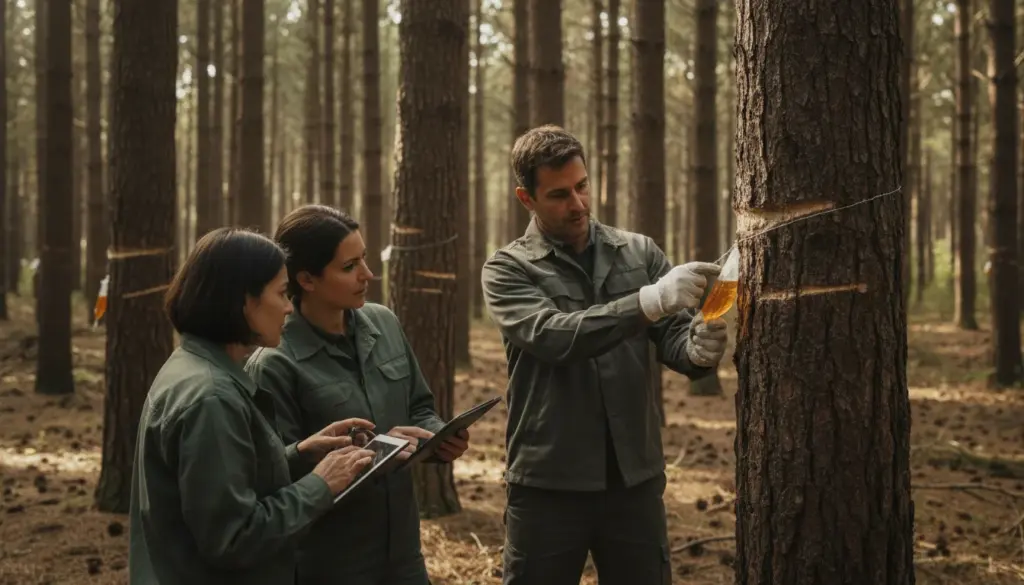
Scientists at the Misión Biológica de Galicia (CSIC) closely observed pines subjected to regular tapping to understand exactly how they manage this type of repeated injury. The findings were highly revealing. Even though the tree registers physical damage every fifteen days, its immune system kicks into high gear precisely at the site of the incision.
The most crucial takeaway is that over a short-term window of three to five years, researchers found no statistically significant reduction in overall growth. Essentially, landowners can safely extract this valuable raw material without sacrificing the future timber volume they plan to harvest. It is a highly pragmatic natural response; the tree actively defends the localized wound while seamlessly continuing to build its core structure.
The Surprising Link Between Bark Wounds and Seed Production
During these trials, biologists noted a fascinating biological defense mechanism. When a pine senses danger—which is exactly how it interprets bark incisions—its basic survival instincts take over and force it to drastically ramp up seed production. The organism instinctively assumes it is under severe threat and urgently prepares to secure the next generation.
This dynamic creates a highly favorable scenario for forest owners:
- The tree successfully maintains its overall vitality and health.
- Landowners unlock a completely new revenue stream through sustainable resin collection.
- Natural forest regeneration happens much faster thanks to the sudden abundance of seeds.
- The trunk’s localized immunity at the tapping site actually grows stronger.
The Hidden Catch High in the Canopy
However, there is a minor drawback to this rapid profit model that warrants careful attention. While the main trunk thrives, scientists indicate that shifts in nutrient distribution often occur much higher up in the tree’s crown. The concentration of natural defense compounds and essential nutrients noticeably drops in the upper branches.
This isn’t an anomaly, but rather pure biology at work. The tree actively redirects its available energy to heal the specific area under immediate stress. Because of this, forestry experts strongly advise against complacency. Long-term monitoring is crucial, especially during challenging seasons marked by severe droughts or sudden pest outbreaks. Under extreme environmental stress, a depleted canopy could become a genuine liability. (Considering the unpredictable weather patterns we’ve experienced recently, staying vigilant with woodland management plans is always a smart move.)
The Future of Resin Harvesting
While researchers acknowledge the need for expanded studies on larger tree populations to understand the full ten-year impact of continuous extraction, the current outlook is incredibly positive. Right now, the only real red flag associated with this technique is that slight dip in canopy-level defenses.
Have you ever experimented with resin tapping on your own woodland property, or do you strictly stick to traditional timber harvesting? Share your approach to forest management!