Long before modern eyewear existed, our ancestors didn’t just walk around squinting at the world. They developed incredibly clever methods to read, spot danger, and perform intricate craftsmanship. From polished stones to water-filled vessels and strategic lighting, historical solutions for poor vision were surprisingly resourceful.
Living with Failing Eyesight in the Distant Past
If you struggle with nearsightedness or age-related vision changes today, you simply visit an eye specialist. During antiquity and the Middle Ages, that luxury was entirely unimaginable. Yet, blurred vision, double sight, and severe ocular conditions were just as common in historical societies as they are now.
The human body naturally adapted to some extent, with youthful eyes flexing to compensate for minor defects. However, once individuals reached their forties, focusing on close objects inevitably became a biological challenge. In an era where survival and commerce often depended on millimeter-precise tasks like carving, weaving, and writing, failing eyesight presented significant hurdles.
Losing your near vision didn’t mean losing your intellect, but it certainly limited your opportunities. Many individuals were forced to abandon specific trades, rely on youthful apprentices, or simply accept a blurrier existence. Still, the human drive to find practical visual aids never truly ceased.
The Earliest “Lenses”: Crystals, Stones, and Water
Transparent Quartz as a Primitive Magnifier
Early civilizations eagerly experimented with translucent materials to manipulate their view of the world. Around 750 BC, ancient inhabitants of modern-day Iraq crafted the Nimrud lens, a polished piece of rock crystal discovered by archaeologists. This fascinating artifact perfectly resembles a crude optical lens and offers a slight magnifying effect.
Whether individuals with failing sight actually used this crystalline disc remains a topic of historical debate. Experts suggest several potential applications for the ancient object:
- Acting as a visual magnifier for intricate engraving and metalwork
- Serving as a burning glass to effortlessly ignite fires
- Functioning purely as a decorative or ceremonial item
Other ancient regions also utilized polished, glass-like stones designed to concentrate light. Even if their primary purpose wasn’t always medical vision correction, these artifacts provided foundational knowledge regarding early optical physics.
Glass Spheres and Water Bowls
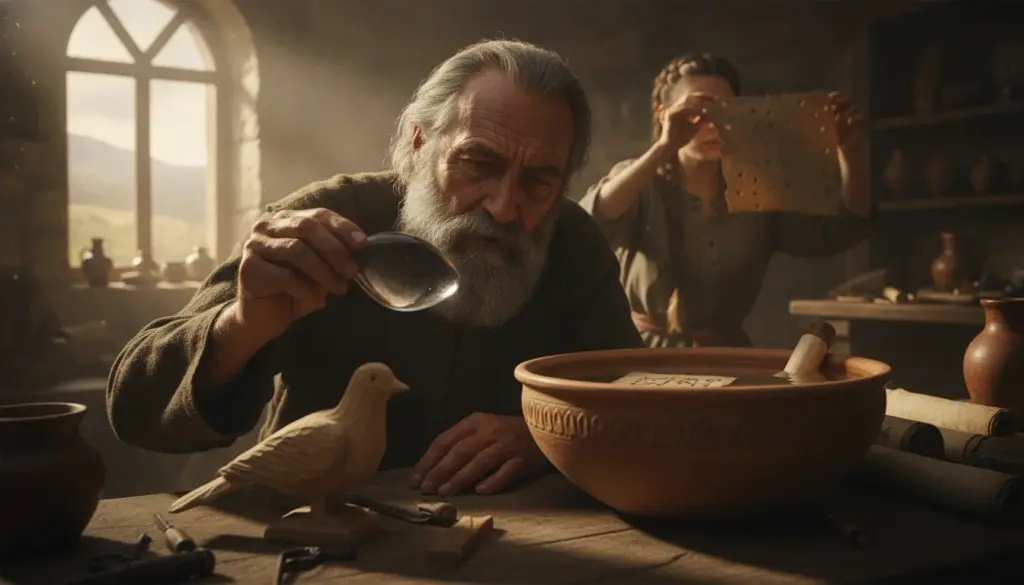
Another ingenious tactic involved peering through clear, water-filled bowls or solid glass orbs. When someone placed a manuscript beneath these vessels, the letters appeared noticeably larger and sharper to the naked eye. Historical records frequently describe these glass spheres as “reading stones,” which were heavily favored by early scribes and academics.
These primitive aids were completely stationary, requiring users to rest them on desks or slanted lecterns. Instead of wearing the device on your face, you actively maneuvered the document underneath it. This physical approach perfectly solved the daily struggle of deciphering tiny text and performing detailed manual labor.
From Islamic Science to the European Reading Stone
Alhazen and the Dawn of Optics
A monumental leap forward occurred during the Middle Ages, spearheaded by the brilliant Arab polymath Ibn al-Haytham, widely known in Europe as Alhazen. Around the year 1000, he authored comprehensive studies detailing exactly how light enters the human eye, the mechanics of magnification, and the biological reasons behind vision loss.
European scholars eventually translated his groundbreaking manuscripts, which fundamentally shifted their approach to optics. They began treating glass curvature and light refraction not merely as fascinating curiosities, but as vital, practical technologies designed to improve human life.
Monks and the Indispensable Reading Stone
This influx of knowledge birthed the European reading stone: a thick, hemispherical lens crafted from crystal or glass that enlarged flat text. Monastic scribes, who spent agonizing hours copying illuminated manuscripts by hand, became the primary adopters of this groundbreaking tool.
Users would place the curved stone directly onto the parchment, instantly increasing both magnification and visual contrast. For aging monks struggling with presbyopia, this invention was nothing short of miraculous. It allowed for significantly longer working hours, even though the heavy stone had to be manually dragged across every single line of text.
The reading stone ultimately served as the direct predecessor to modern glasses, providing enlarged letters and static texts for skilled workers who would have otherwise burned out their eyes entirely too soon.
The Invention of Spectacles: A Wearable Revolution
Italy as the Birthplace of Modern Eyewear
True wearable eyeglasses finally emerged in Italy near the close of the thirteenth century. These initial designs lacked modern temples or rigid frames, consisting instead of two circular lenses joined by a central rivet or pin. Wearers either pinched them delicately onto their nose or held them up by hand.
Cities renowned for their glassmaking prowess, particularly Venice and the island of Murano, drove this incredible innovation. Master artisans figured out how to grind glass with precise curvatures that manipulated light predictably. From these specialized Italian workshops, spectacle-making techniques slowly rippled outward across the European continent.
A Status Symbol for the Elite
During their infancy, eyeglasses were exceptionally rare and prohibitively expensive. They were exclusively utilized by a select few:
- Clergy members and monks tasked with interpreting sacred manuscripts
- Legal scholars and academics managing mountains of complex paperwork
- Wealthy merchants balancing extensive financial ledgers
As the Renaissance blossomed, spectacles frequently appeared in portraiture as powerful symbols of intellect and authority. An elderly notary sporting a pair of early glasses projected wisdom, education, and affluence rather than physical frailty.
Practical Adjustments Before Optical Aids
Manipulating Light, Distance, and Size
When optical technology was unavailable, communities cleverly adapted their physical environments to accommodate failing eyesight. Everyday survival relied heavily on these environmental modifications:
- Maximizing natural daylight: Crafting tables were pushed directly against windows, or intricate work was moved entirely outdoors.
- Adjusting focal length: Nearsighted individuals held objects mere inches from their faces, while those with farsightedness stretched their arms out completely.
- Enlarging visual cues: Public inscriptions, commercial symbols, and important markings were carved at massive scales so everyone could decipher them.
- Boosting stark contrast: Using pitch-black ink on bright white parchment made individual characters drastically easier to distinguish.
Daily routines revolved tightly around the sun’s position. Intricate embroidery, fine carving, and reading were strictly midday activities. Once evening fell, candlelight signaled an immediate shift toward coarse physical labor or purely oral storytelling.
Social Delegation and Teamwork
Families and professional guilds also developed highly effective collaborative strategies. A master artisan with fading vision would delegate excruciatingly detailed tasks to young apprentices possessing sharp eyesight. In exchange, the elder provided unmatched technical expertise and mentorship.
Generational cooperation was equally vital. Young children regularly read aloud to aging grandparents who could no longer decipher written correspondence. By naturally dividing tasks based on visual capabilities, entire communities successfully masked individual impairments through teamwork.
Navigating Life with Severe Vision Loss
Historically, ocular issues extended far beyond simple blurriness. Rampant eye infections, occupational hazards, congenital defects, and wartime injuries were devastatingly common. Without modern antibiotics or sterile surgical procedures, a minor scratch could easily deteriorate into permanent, irreversible blindness.
Those who lost their sight completely had to cultivate extraordinary reliance on touch, scent, and hearing. They memorized intricate town layouts and learned to identify objects and neighbors solely by their ambient sounds or physical patterns. Many maintained active community roles by working in familiar market settings, pursuing musical careers, or taking on specific religious duties.
The Printing Press Exposes a Global Problem
The fifteenth-century introduction of the printing press fundamentally altered the trajectory of optical history. As books transformed from rare luxuries into affordable commodities, literacy rates surged across massive populations. Suddenly, thousands of eager new readers realized their eyesight was completely inadequate.
This cultural shift triggered an unprecedented demand for spectacles. What had once been an elite status symbol rapidly evolved into a mass-market necessity. Bustling city markets began hosting vendors selling ready-made glasses in various generic strengths, functioning much like the accessible reading glasses found in modern pharmacies.
Ultimately, mass-produced literature didn’t just democratize knowledge; it completely exposed a widespread biological flaw. An entire generation simultaneously discovered that the written word only holds power if you can actually see it clearly.
What Ancient Ingenuity Teaches Us Today
The historical journey of vision correction highlights an undeniable truth about human nature: we adapt to our physical limitations with astonishing speed. Lacking advanced medical technology, early societies simply engineered better ways to manipulate lighting, distance, and community support.
Fascinatingly, these ancient strategies remain incredibly relevant. In remote global regions lacking basic eye care infrastructure, you will still witness children reading in direct, harsh sunlight, businesses using oversized typography, or families collectively deciphering small print. Providing a basic pair of generic spectacles in these communities still replicates that initial Venetian magic—instantly unlocking a vibrant new reality.
Even those who rely on modern contacts or glasses unconsciously revert to these ancestral habits when their aids are misplaced. We instinctively migrate toward brighter lamps, adjust our smartphone screens to massive fonts, or ask a friend to read a tiny nutritional label. That innate biological adaptability is exactly what allowed our ancestors to thrive for millennia before optical technology became an everyday expectation.